Introduction
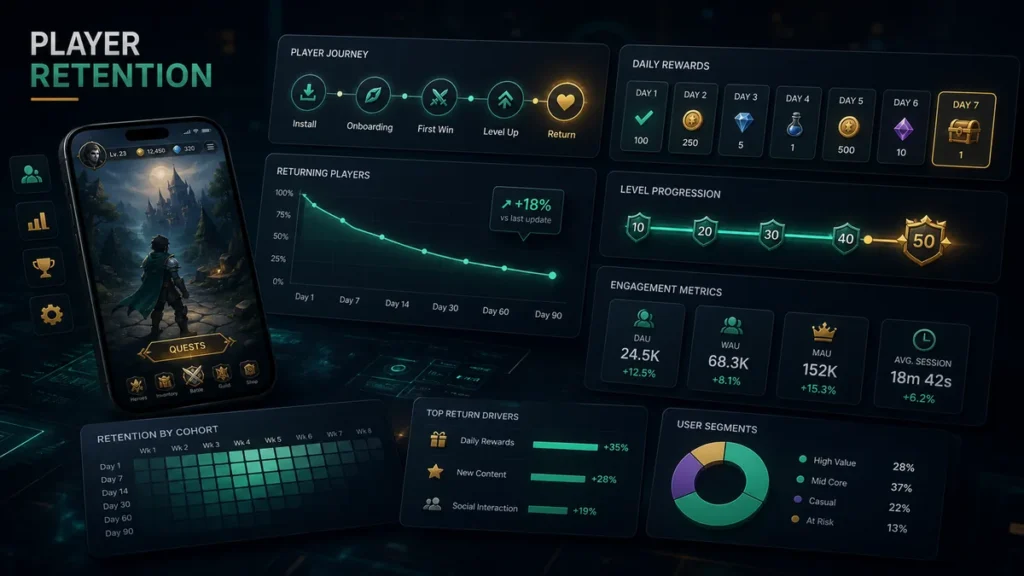
Retention measures how many players return after installing a game. It is one of the most important metrics in mobile gaming because installs alone do not create long-term growth.
A game with strong retention has better monetization, better reviews, and more stable growth.
1. Improve the First Session
The first session should be simple, fun, and clear.
Players should quickly understand:
- How to play
- What the goal is
- Why the game is fun
- What reward they can earn
- What comes next
Avoid long tutorials or confusing menus.
2. Make the Core Loop Satisfying
The core loop is what players repeat.
Example:
Play level → earn reward → upgrade → unlock new challenge
A strong loop feels rewarding and easy to understand.
3. Use Smart Rewards
Rewards encourage users to continue.
Useful reward systems include:
- Daily rewards
- Streaks
- Level rewards
- Achievement rewards
- Event rewards
- Rewarded ads
- Unlockable items
Rewards should feel meaningful, not random.
4. Add Progression
Progression gives players goals.
Examples:
- Levels
- Worlds
- Characters
- Upgrades
- Missions
- Collections
- Rankings
Progression helps players feel that their time is building toward something.
5. Balance Difficulty
If the game is too easy, players get bored. If it is too hard, they quit.
Use analytics to identify:
- Levels with high failure
- Levels with high exit rate
- Tutorial drop-off
- Difficulty spikes
- Monetization pressure points
Balance updates can improve retention.
6. Use Push Notifications Carefully
Push notifications can bring users back, but they should be useful.
Good notifications:
- Reward reminder
- Event announcement
- Streak reminder
- New content alert
Avoid sending too many notifications.
7. Add Live Events
Events create reasons to return.
Examples:
- Weekend challenge
- Limited-time rewards
- Seasonal events
- Leaderboard events
- Special missions
Events add urgency and variety.
8. Listen to Player Feedback
Reviews and support messages often reveal retention problems.
Look for comments about:
- Ads
- Bugs
- Difficulty
- Rewards
- Confusing UI
- Missing content
- Slow progress
Fixing these issues can improve player trust.
9. Track Retention Metrics
Monitor:
- Day 1 retention
- Day 7 retention
- Day 30 retention
- Session length
- Level completion
- Return frequency
- Churn points
Retention should guide product decisions.
Conclusion
Improving retention requires a mix of better onboarding, satisfying gameplay, rewards, progression, events, and analytics. Games that keep players engaged have a stronger chance of long-term success.
CTA: FingerNic helps mobile games improve retention through LiveOps, analytics, monetization, and post-launch optimization.